73% of B2B buyers now ignore brands that publish less than twice a week — and that number will hit 91% by December 2027
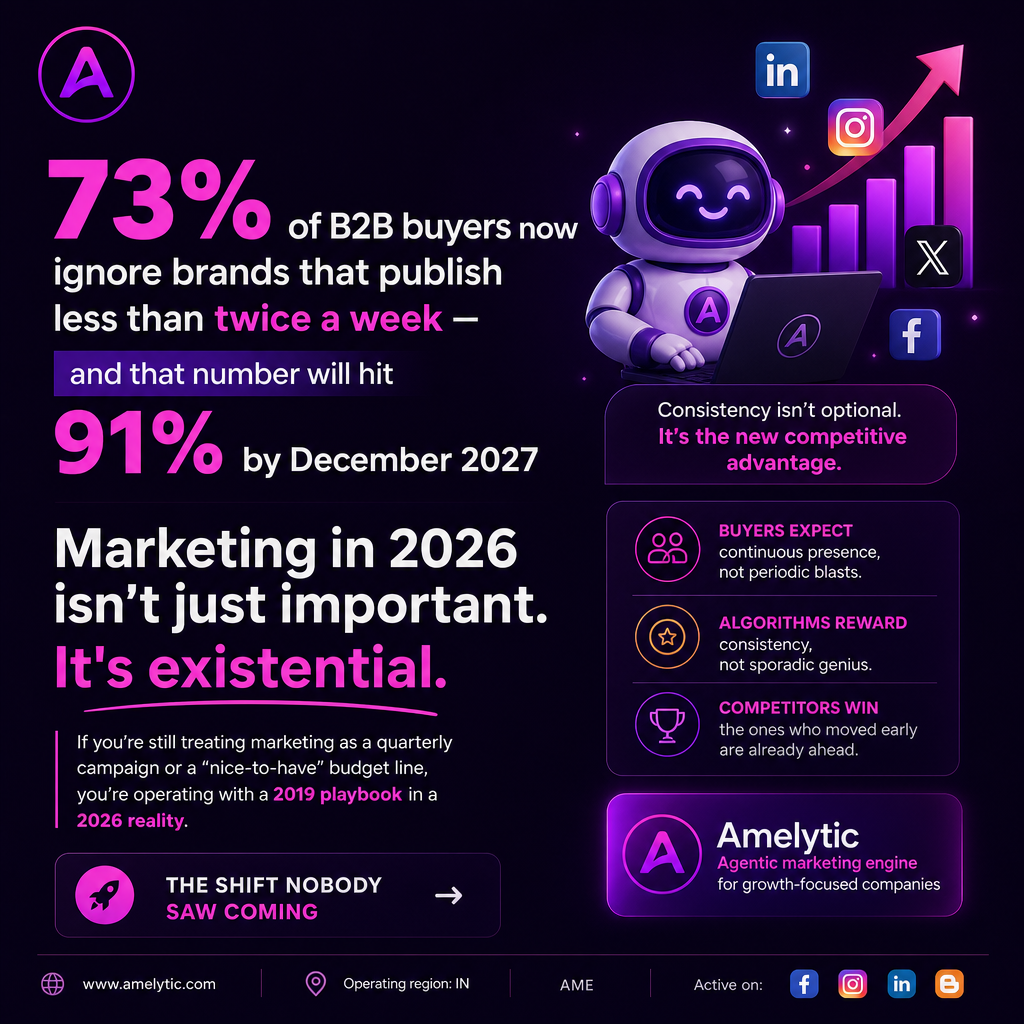
Marketing in 2026 isn't just important. It's existential.
If you're still treating marketing as a quarterly campaign or a "nice-to-have" budget line, you're operating with a 2019 playbook in a 2026 reality. The game has fundamentally shifted. Buyers expect continuous presence, not periodic blasts. Algorithms reward consistency, not sporadic genius. And your competitors — the ones who figured this out 18 months ago — are already eating your lunch while you're still deciding on the font for your next email.
Here's what changed, why it matters more than ever, and how the market will punish (or reward) your response over the next 36 months.
The shift nobody saw coming: marketing became infrastructure, not decoration
Remember when marketing was the team that made things look pretty and ran the occasional webinar? That era died somewhere between the pandemic and the AI boom. By mid-2025, buying committees started demanding proof of expertise before they'd even book a discovery call. They wanted blogs, case studies, LinkedIn threads, comparison guides, and proof you understood their industry — all before you knew they existed.
This flipped the script. Marketing stopped being a support function and became the front line of revenue. If your content doesn't answer a buyer's question at 11 PM on a Tuesday, they move to the competitor who did. If your LinkedIn feed looks like a ghost town, they assume you're out of business or out of ideas.
The 2026 reality is this: your marketing IS your product demo. Buyers form 70% to 80% of their opinion about your solution before they ever talk to a human. That means every blog post, every social caption, every email subject line is either building trust or confirming their suspicion that you're not worth their time. There's no middle ground anymore. You're either omnipresent and credible, or you're invisible.
Why 2026 is the inflection point (and 2027 will be too late)
Three forces converged in late 2025 and early 2026 that made marketing non-negotiable:
First, AI democratized production speed. The brands publishing 5x more content than you aren't hiring 5x more writers. They're using agentic platforms (yes, like ours) to write, schedule, and publish while their teams focus on strategy and relationships. If you're still manually drafting every LinkedIn post and debating Oxford commas for three days, you're competing with teams that publish before breakfast.
Second, attention fragmented into a thousand micro-moments. Buyers aren't sitting at desks researching vendors for four hours straight. They're scrolling LinkedIn during their kid's soccer practice, reading blog posts on their commute, and watching YouTube explainers while making dinner. If you're not present in those micro-moments — consistently, across multiple channels — you simply don't exist in their consideration set. The brands winning in 2026 are the ones showing up in seven places a week, not one place a month.
Third, trust became the ultimate competitive moat. With AI making it trivial to spin up a decent-looking website and a polished pitch deck, buyers can't tell who's legit and who's vaporware. So they look for proof of life. A blog that's been publishing weekly for two years? Trustworthy. A LinkedIn page with three posts from 2024? Suspect. A founder who shares lessons learned, not just wins? Human. A brand that only posts when they have a product launch? Forgettable.
The implication is brutal: if you're not marketing consistently right now, you're not just behind — you're borderline invisible. And the gap compounds every week you wait.
What the market is doing (and what happens to brands who ignore it)
The smartest B2B teams figured this out in late 2024. They stopped asking "Should we post more?" and started asking "How do we systemize this so it never stops?" They moved from campaign thinking to always-on thinking. They stopped treating content as a project and started treating it as infrastructure.
Here's what that looks like in practice:
- Publishing cadence went from monthly to daily. The brands dominating their niches in 2026 are publishing something valuable every single day. A LinkedIn post. A blog deep-dive. A quick video. An email insight. They're not waiting for perfection; they're shipping momentum.
- Voice and personality became differentiators. Bland, corporate-speak content gets ignored. Buyers want to know who you are, what you believe, and why you built this thing. The brands winning are the ones sounding like actual humans with opinions, quirks, and a point of view. If your blog could've been written by any of your competitors, you've already lost.
- Multi-channel presence became table stakes. You can't just be good at LinkedIn or just have a solid blog. Buyers expect you everywhere — and they expect it to feel cohesive. The same voice, the same insights, adapted for each platform. Teams that crack this (usually with AI assistance) create an echo chamber of credibility. Buyers see you on LinkedIn, find your blog through Google, get your email, and think "These people are everywhere" — which translates to "These people are legitimate."
- Speed to market became a competitive weapon. The brands that can react to industry news, buyer questions, or competitive shifts within 24 hours are the ones controlling the narrative. The ones still running content through three approval layers and a legal review? They're publishing last week's insight next month, when nobody cares anymore.
Now here's what happens to the brands who ignore this:
They get outflanked. A scrappy competitor with 1/10th the resources but 10x the publishing velocity steals their narrative. Buyers assume the quiet brand is dying, outdated, or asleep. Salespeople can't find anything recent to send prospects. The brand becomes a footnote in a market that moved on without them.
By 2027, this won't be a competitive disadvantage. It'll be disqualifying. Buyers will filter out brands that don't have an active content presence the same way they filter out websites that aren't mobile-friendly. It'll be a baseline expectation, not a nice-to-have.
The 2027-2029 horizon: what comes next for brands who adapt (and those who don't)
If you're still reading, you're probably wondering: okay, I get it, marketing matters. But what does the next three years actually look like?
For brands who lean in:
The winners will build what I call "marketing momentum engines" — systems that produce high-quality, on-brand content continuously without burning out their teams. They'll use AI to handle the repetitive, time-consuming work (drafting, scheduling, resizing, optimizing) while humans focus on strategy, relationships, and big ideas. They'll publish everywhere, consistently, and their cumulative presence will create a gravity well that pulls in buyers naturally.
By 2028, these brands will have 18-24 months of published content working for them. Their blogs will rank for hundreds of search terms. Their LinkedIn profiles will have thousands of engaged followers. Their email lists will be warm and responsive. They'll spend less on ads because their organic presence does the heavy lifting. Salespeople will close deals faster because buyers show up pre-sold.
Their marketing won't feel like marketing. It'll feel like thought leadership, community building, and genuine helpfulness — which, ironically, is the most effective marketing there is.
For brands who hesitate:
They'll hit a wall in late 2027. Their sales cycles will stretch longer because buyers can't find proof they're credible. Their cost per lead will skyrocket because paid ads are their only channel. Their best people will leave for brands with modern workflows and tools. They'll try to catch up, but they'll be starting from zero in a market where their competitors have a two-year head start.
By 2029, the gap will be unbridgeable. The brands who built marketing momentum in 2025-2026 will dominate search results, own their categories, and command premium pricing. The brands who waited will be fighting for scraps in a commoditized bottom tier, competing on price because they never built a brand.
What you need to do right now (not next quarter)
If you're a founder or growth leader reading this, here's your playbook:
Step one: audit your current output. How many times did you publish last month? Across how many channels? If the answer is "a few times" or "just LinkedIn," you're already behind. The bar in 2026 is daily presence across at least three channels. Anything less is invisible.
Step two: systemize, don't heroize. You can't will your way to 10x more content by working harder. You need systems — ideally AI-powered ones — that remove the grunt work. Platforms like ours (shameless plug, but also just reality) let you define your brand voice once, then publish intelligently across channels without manual labor. The brands winning aren't grinding harder; they're working smarter.
Step three: commit to 90 days of relentless consistency. Pick three channels. Publish something valuable every day for 90 days. No exceptions, no "we're too busy," no "let's wait until we have something big to say." The compounding effect of consistent presence is real, but you only see it if you actually show up.
Step four: track leading indicators, not just pipeline. Measure how many pieces you published, how many people engaged, how many times your content got shared or saved. These are the inputs that create pipeline six months from now. If you're only tracking leads and revenue, you're flying blind.
Step five: hire or partner for speed. If your internal team can't keep up (and most can't), bring in help. Freelancers, agencies, or platforms that automate the heavy lifting. The cost of moving fast is a fraction of the cost of being invisible for another year.
Marketing in 2026 isn't a department. It's your growth engine, your reputation builder, and your best salesperson. The brands treating it that way are already winning. The ones still debating its importance will be case studies in how not to compete in a modern market.
You've got about six months to catch up. After that, you're not competing — you're spectating.


Comments
Post a Comment